
The Time for Forging

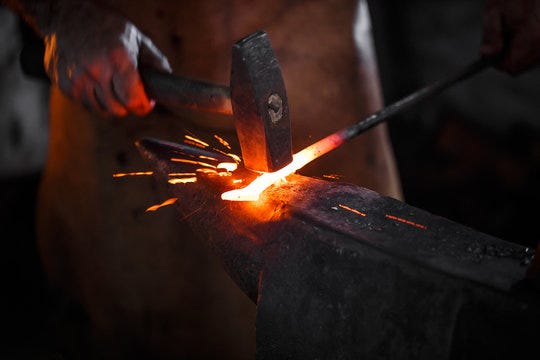
Some of my friends and colleagues are worried about me. I know that because when I talk to them on the phone, they say: we’re worried about you. I get it. Over the past year or so, I’ve loosened my discursive belt and said things in public that I would have never said before. My friends are concerned about the consequences of my actions.
At the same time, I’ve also gotten a lot of enthusiastic emails from young people: graduate students, up-and-coming writers, early career faculty. They’ve told me: we’re reading you, we agree with you, keep saying what you’re saying. Some of them are Latin Americans (including many Mexicans), and they tell me: we’re tired of the nepotism, the corruption, the ritualized systems of professional abuse. Others are American, and they say: we are sick of the ideological purity tests, the business-as-usual approach to scholarly production, the constant deference politics.
At one point last semester, I asked a graduate student what literary scholarship he was reading, and he said, to be honest, I’ve been reading your Substack. I do not say this to be self-congratulatory. This is not about me per se. What is happening is that our entire system—political, economic, cultural, educational—is in crisis, and we still do not have the language to deal with that crisis adequately. The macro-context in the United States is clear: an authoritarian government that is increasingly turning toward armed paramilitary action in the streets; a president who openly disavows the principles of national sovereignty at the heart of the international order; a Democratic Party that still can’t tell its Mamdani from its Klobuchar. What remains unclear is how we respond to this at the intellectual level. Writers and scholars tried resistance anti-Trumpism for eight years and it didn’t work. We desperately need new paradigms of thought. This is not a knock against struggle, political or otherwise. What matters is how we conceptualize that struggle in the institutions of culture in this country.
In my view, part of what young people are expressing is a desire to think beyond the theoretical traditions they have inherited from an American academy in decline. If, as is often said, the intellectual right has the momentum right now, this is in part because many of its thinkers have had the temerity to question fundamental structures in ways that most progressives have feared to do. By questioning fundamental structures, I do not simply or primarily mean questioning the authoritarian political apparatus of Trump—we’ve done that and will continue to do it. What I mean is questioning the modes of inquiry and validation in our own liberal institutions. Every time someone says, how can we talk about anything but ICE right now, I think, how can we not talk about everything that led us to this moment.
So I want to say in public to all those friends, I’m good. I’m taking the approach I want to take. I’ve gone hard in some recent debates in the post-1945 US literary field, and others have gone hard in turn. I continue to engage with the scholarship of the folks I’ve debated, and they are increasingly engaging with mine. Those who read my Spanish-language writing know I have made severe criticisms of aspects of the Latin American literary world. I stand by everything I’ve written. There is a tremendous amount of fear and material precarity right now in the academic and cultural worlds. Not all of us can say what we want to say, and some may feel that they can say nothing. For those of us who have tenure at robust institutions, however, I don’t see why we shouldn’t be laying ourselves on the line.
Over the past few weeks, I’ve been thinking about a famous sentence from the Cuban poet José Martí’s essay “Our America”: “Es es la hora de los hornos, y no se ha de ver más que la luz”, which I would roughly translate, “This is the time for forging, and let nothing be seen but its light.” The interpretations of the line in the Latin American political and cultural tradition are legion. I choose to read it as a general call to creation, to fashioning new things whose value will be demonstrated by the energy (the light) they produce. The counterargument to Martí’s line is obvious, since we use it all the time: don’t play with fire, because you might eventually get burnt. Creation or conservation, impulse or discretion, challenge or quiescence—these are questions we ask ourselves all the time, both individually and collectively. Right now, for me, this is a time for forging. I hope others join in that endeavor.
Good thoughts, Jeffrey.
There was no question in certain quarters about how to respond a hundred-plus years ago. Many forward-looking, left-wing publications from the 1800s and early 1900s remain incredibly inspiring, inspired, and much of it reads very, very contemporaneously: The Masses, The Liberator, The New Masses, Appeal to Reason, Mother Earth, The Coming Nation, The National Era, New National Era…
Great work has been done putting these remarkable journals online, freely accessible to all. Some of these periodicals, newsletters and magazines, were created during what might be considered the most socialist age of America, in a long arc of enlightenment and human rights thinking and action. Lots of insight and inspiration there very useful for today. Lots of inspired intellectual activity, including artistic activity.
Don't get burned, friend, we need your mind for the long struggle, the real one. (as for your beef, never have I been happier to not belong at all to that superficial and cutthroat world of the literary establishment for which I am and will happily continue to be a nobody). Te quiero y sí, me preocupo por ti y por tu mente de la que he aprendido tanto, tantísimo, estás por ahí en todos mis libros de alguna manera.