

A few days ago, I had a long conversation with my friend Bécquer Seguín about the state of literature and publishing in the United States and the Spanish-speaking world. Though his name might suggest otherwise, Bécquer was born and raised in the US. Like me, he writes in both Spanish and English.[1] The upshot of our conversation was that Bécquer and I had both reached the conclusion, independently of one another, that Spain is a more hospitable environment for our writing right now than the United States, despite the fact that we are native English speakers and have spent most of our academic careers building our profiles in English-language publications. This might sound crazy. I don’t think it is.
In her recent piece for The Atlantic on the crisis of literacy, “The End of Reading Is Here,” Rose Horowitch discusses the precipitous decline of reading in the United States over the past twenty years. She quotes a 2023 study showing that only 16% of Americans read for pleasure in a given day, down from the (already low) number of 28% in 2004. High school English teachers assign fewer and fewer book-length works, and college students have more and more trouble performing the higher-order interpretive exercises that used to be a staple of literature courses across higher education. For Horowitch, along with many others who have written on the topic, these are among the many signs that we have entered a “post-literate” era.
A study conducted by the Federación de Gremios de Editores de España earlier this year, however, paints a starkly different picture of readership in Spain. According to the study, the percentage of the overall Spanish population that reads for pleasure has increased every year since 2017, reaching 66% in 2025, the highest level ever recorded. Meanwhile, the percentage of the population between 15 and 24 that reads for pleasure rose to just over 76%, a rate that (in the words of the authors of the study) “helps dispel one of the false myths that persists in our [Spanish] society, which holds that young people do not read.” Spanish readers are not immune to the transformations associated with the literacy crisis: the rise of social media platforms, the proliferation of video and audio content, the advent of generative AI. And from speaking to academic friends in Madrid, my sense is that the deterioration of some of the skill sets that Horowitch identifies in her piece can also be detected in Spanish universities. Neverthless, the evidence suggests that, at the least for now, Spain has not only staved off the decline in reading that we’ve seen in the United States but modestly increased readership across the generational divide.[2]
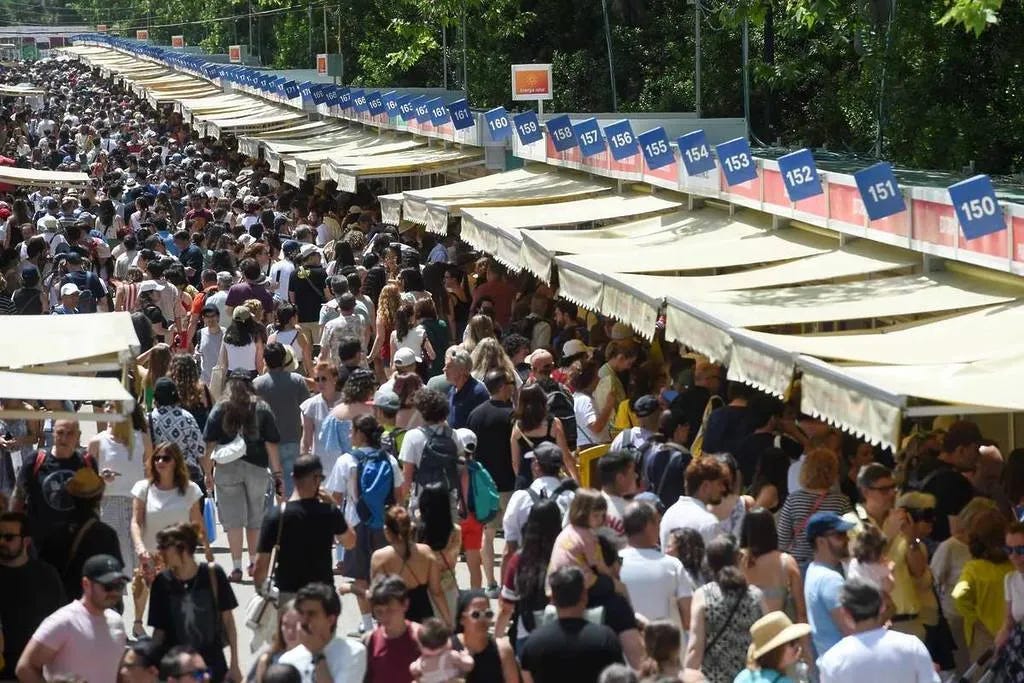
While the survey doesn’t give an explanation for this boom in reading, it is easy enough to identify some of the contributing factors, if only anecdotally. In the first place, public funding for book culture is exponentially higher in Spain than it is in the United States. The Spanish government sponsors book fairs, gives subventions to small presses, funds travel for Spanish authors, and pursues a range of other initiatives both domestically and internationally. The municipally-run Madrid book fair, which takes place every year from late May to mid-June, hosted over 700,000 visitors in 2026. Independent publishers in Spain often compete for notable authors with the imprints of the two major corporate publishers (Penguin Random House and Grupo Planeta), in part because they exist within a well-funded literary ecosystem.
After moving back and forth between New York and Madrid for the past few years, both Bécquer and I have come to feel that complex and intellectually adventurous books are being released in Spain that would never have made the cut in the US. At least in my case, it increasingly seems worth the extra time and effort to write in my second language to reach an engaged and sophisticated reading public, rather than hoping to gain entry to an ultra-competitive US publishing landscape in which an ever-smaller number of authors are truly read.
Obviously, it’s not possible for every American author to switch languages or literary traditions to avoid the most pernicious effects of the US literacy crisis. Bécquer and I have spent decades reading and writing in Spanish, and both of us have the luxury, as tenured professors in American universities, to travel to Spain frequently enough to participate in its cultural environment. Nor do I wish to imply that the Spanish publishing industry is perfect. There is still way more money in Anglophone than in Hispanophone books, in part because of the sheer size of the global English-speaking population, and it remains the case that many authors from Spain and Latin America make their names by having successful translations into English.
What I do want to argue, though, is that the declension narratives about literary culture that have pervaded Anglo-American media outlets in the past few years tend to present culturally specific trends as universal truths. Just because many Western societies face similar problems related to intellectual culture doesn’t mean that they are fated to share the same outcomes of a post-literate society. I suspect that one reason Arts and Letters picked up my provocatively titled piece “On the Superiority of Latin American Literature” this past week is because of a growing anxiety in the United States that our national literary culture is losing ground.
This is partly why, though I am shifting some of my energies toward writing for a Spanish-language readership, I refuse to give up on the readers in the country that I continue to call my home. Once you’ve seen thousands of people come through the Madrid Book Fair in a single day, and once you’ve passed multiple thriving bookstores in a one-kilometer radius, it comes harder to accept as a fait accompli that the next generation of Americans will know nothing other than endless doomscrolling and TikTok videos.
Horowitch ends her essay with a reasonable call to action: “An astonishing wealth of information and wisdom has been bequeathed to us. What we’ll do with this inheritance is up to us.” Yet in the ease with which this American “us” seems to merge into a universal “us” (i.e. the one that is experiencing a civilization-defining crisis), she unwittingly circumscribes the radius in which “we” might find strategies and inspiration to halt “our” decline. I don’t want to suggest that the US should (or could) simply copy the Spanish model. But it does seem clear to me that, precisely because the state of literacy in the US has gotten so bleak, it might behoove American writers, educators, journalists and others to start looking outward in addition to lamenting our own dire circumstances.
My wager is that those of us who inhabit the US cultural world can buck the downward trend, and can do so in our own institutions and in our own lifetime. But at a bare minimum it will require us to stop assuming that what is happening in the US is happening everywhere else, and that we are the only barometers of the future.
[1] Last week Bécquer published a co-authored piece on Spanish prime minister Pedro Sánchez in English for The Nation and an op-ed on AI and recent literary scandals in Spanish for El Mundo. I highly recommend the former for anyone in the US who wants an accurate and in-depth survey of the current political situation in Spain.
[2] The study notes that the proportion of Spaniards over the age of 65 who read in their free time increased 13% from 2017-2025.
You’re comparing two surveys with very different methodologies. The American numbers came from a time use survey where Americans were asked to fill out a diary on how they used their time in the preceding day. As far as I can tell, the Spanish survey was just a survey where people were asked whether they had read a book in the previous year.
The US also has a survey w a similar methodology as the Spanish survey, and that would be a better comparison. Not saying there is no difference, but the way you have reported the data here overstates the difference. https://www.arts.gov/stories/blog/2024/federal-data-reading-pleasure-all-signs-show-slump
The Premio Planeta de Novela (the Planeta sponsored literary awards) offers 1,000,000€ first prize and 200,000€ for runner up. Yes, 1 million euro.
The Booker Prize (the literary award for books written in the English language) £50,000 (approximately 58,500€).
The Donald Windham Sandy M. Campbell Literature Prize is the most generous literary prize for books written in the English language and pays out $175,000 (approximately 153,000€).
Surely an indicator of how literature and books and their value are perceived by Hispanic and Anglo cultures?