
Immersive Versus Close Reading
Reflections on Naomi Kanakia's What's So Great About the Great Books?

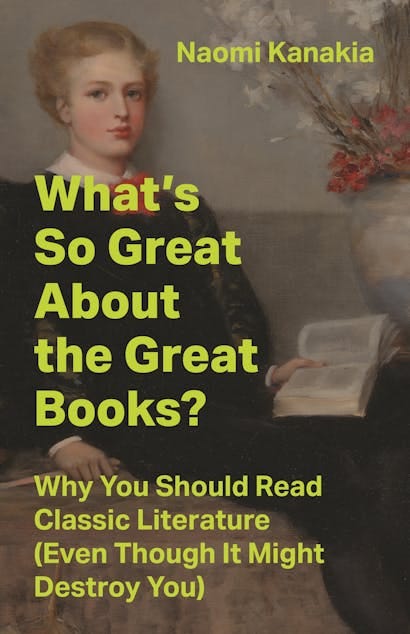
Just a few pages into Naomi Kanakia’s What’s So Great About the Great Books: Why You Should Read Classic Literature (Even Though It Might Destroy You), released last week from Princeton University Press, the author lays out the method by which she conquered over a hundred of the “greatest” books of all time. “I read these books the same way I read everything else,” she observes, “I sank into the dream of the text, experiencing it with as much immediacy as I could.” Kanakia readily admits that, by reading the classics outside of the institutional setting of the university (“No papers. No discussions”), there was much she had missed: “Some things I understood well, others I understood poorly, and some things I understood not at all.” Nevertheless, she insists that she chose this private, immersive approach to the canon partly because she had struggled to conform to the expectations of her college English courses, where she had encountered a “strange way of reading, close reading,” that forced her to pretend “there was some meaning” in the literary works she was assigned that “to my eyes, didn’t really exist.” A few paragraphs later, she returns to the difference between her own reading practice and the mode of textual analysis typically used to initiate students into literary study in the classroom. “This book is, in part, a defense of lay reading,” she asserts, since “for most people, in most situations, lay reading is much more fruitful than close reading as a way of engaging with texts.”
For those of us who make a living through what Kanakia calls “professionalized reading”—which is to say, for most literature professors—it is difficult not to take this opening as a bit of a gauntlet throw. Over the past few years, following many decades in which academic literary scholars tended to view “close reading” as a practice that had been superseded by historicist and/or theoretical methods, the term has come back into vogue. In his 2023 book Criticism and Truth: On Method in Literary Studies, Yale English professor Jonathan Kramnick asserted that “literary critics do many things in the creation and circulation of knowledge, but when it comes to their published work, the practice that sets the discipline apart from others is close reading.”
Two years later, the eminent literary scholar John Guillory published a slim volume of essays on close reading, called On Close Reading, which argued that the term had emerged historically less as a coherent designation for what all literary scholars “do” than as a rallying cry. According to Guillory, while scholars began to refer to “close reading” in the mid-twentieth century to differentiate dense verbal analyses of poetry from traditional literary history, close reading had resurfaced in recent years largely to challenge the growing influence of “distant reading,” i.e. the practice of drawing conclusions about literary works through the computational analysis of large data sets (i.e. hundreds or even thousands of novels). In the most recent contribution to the debate, last year’s Close Reading for the Twenty-First Century, Dan Sinykin and Johanna Winant offered perhaps the clearest definition of what close reading entails—”the practice of paying attention to a passage of text to account for at least one aspect of its meaning and to make an argument about how it works”—and a five-step process by which most literary scholars achieve it.
I will say up front that I’m a close reading fan. I did my undergraduate degree at a liberal arts college where close reading hadn’t quite fallen out of favor to the extent it had at larger research universities. And though I write criticism on a variety of topics, including literature, culture, sports, and politics, I always take pains to bring the language of the texts I read into my own analysis, to weave my “words with words that precede and shape them,” as Kramnick’s definition of close reading has it. In our age of distracted attention, when so many different kinds of information compete for our eyes and our minds, I see value in teaching young people how to slow down and concentrate on a single body of text, to wrest some meaning from a few sentences rather than the endless scroll of data they are exposed to everywhere else in their daily life. In this sense, I’m glad that Sinykin and Winant’s provide a lucid, step-by-step explication of close reading in Close Reading for the Twenty-First Century that demonstrates how our students can move from noticing aspects about a specific passage in literature to making a broader argument about what that passage says about the world (or about language, or relationships, or culture).
At the same time, it seems evident to me that defending and explaining close readings of texts will only get those of us who dedicate our lives to literature so far. The rise of close reading in the early post-World War II period as a deliberate, time-intensive practice coincided with the massive growth of literary studies as an academic discipline. The assumption was that the scholars who made the best arguments about texts would be hired to teach those texts for a living, and that, once installed as professors in their respective universities, they would have a large and captive audience of students ready to learn that same practice from them. These days, however, neither of those conditions obtain. The humanities hiring crisis of the past two decades has meant that fewer and fewer young scholars receive academic jobs by doing good interpretive work, and it has become clear from data on the growing literacy crisis that the number of young people who read for pleasure, let alone enroll in literature classes, has rapidly dwindled. Debating how we should teach the students who enroll in our classes is important. But how do we make the case for literature to those who aren’t already in our classrooms, and who may not be disposed toward reading in the first place?
It is this crisis in the transfer of literary knowledge that gives What’s So Great About the Great Books its fresh and even radical appeal. In the introduction, Kanakia pitches her book as an alternative to other books about the Great Books, including Allan Bloom’s The Closing of the American Mind, William Deresiewicz’s Excellent Sheep, and Roosevelt Montás’s How the Great Books Changed My Life and Why They Matter for a New Generation. And it’s true, as Kanakia points out, that her book differs from those others in that it makes a case for individuals to read the classics on their own, rather than for American universities to restore these books to their prior place in the curriculum. Personally, however, I’m less compelled by this specific difference from her Great Books precursors than I am by her efforts, in dialogue with those authors, to document what a committed project of literary education looks like in 2026 outside of the traditional pathway of the PhD. Perhaps even more so than Kanakia herself acknowledges, the program that she offers in What’s So Great About the Great Books is valuable precisely because the bonds linking the liberal arts to our current educational system have frayed so badly. For the first time in a long time, we must seriously contemplate how intellectual culture in the United States will survive in the face of widespread institutional decline. Kanakia’s program for twenty-first-century literary Bildung is her own, but it bears important resemblances to other burgeoning initiatives on Substack and elsewhere (including Justin Smith-Ruiu’s The Hinternet, John Pistelli’s The Invisible College, and Catherine Liu’s Palm Springs School for Social Research) that are seeking to imagine a future for the humanities beyond the traditional confines of the university.
What’s So Great About the Great Books advances its autodidact’s argument for the classics in two parts. The first is organized around what the Great Books really are (“What do you mean by ‘The Great Books?’”, “Have people always read the Great Books?” etc.), and the second around why we should keep reading canonical works whose politics diverge from contemporary liberal/left sensibilities (“Aren’t the Great Books kinda problematic?,” “When we say, ‘The Great Books are worth reading,’ do other people hear, ‘White men are inherently superior’?”). As these latter chapter titles indicate, another obvious backdrop for the book is the rise of cancel culture over the past decade and a half, as well as the intensification of the culture war critiques of the Western canon that originally motivated (Allan) Bloom to write The Closing of the American Mind.
Kanakia moves through these hypothetical queries with the direct, incisive style that readers will recognize from her Substack newsletter Woman of Letters. The majority of the chapters begin by laying out a standard assumption about the Great Books, and then proceed to subject that that assumption to a rigorous, no-nonsense interrogation from multiple vantage points. The chapter titled “Why not read other books that are equally beautiful but have better politics?” provides a good example of Kanakia’s ability to cut through the pieties of contemporary discourse. Unlike many contemporary defenders of the Great Books, Kanakia believes that the prejudices we find in classical works of literature do in fact often derive from objectionable attitudes among their authors. For instance, Edith Wharton’s antisemitism comes through in the character of Rosedale in The House of Mirth, just as Tolstoy’s traditionalist views on the role of women (which in our era would certainly register as misogynistic) affect his portrayal of Anna in Anna Karenina. Yet unlike contemporary progressives who adhere to what we might call the sensitivity school, Kanakis recognizes that strongly held beliefs are often the starting point for the literature that endures. The common denominator of the Great Books is that they struggle with complex and often uncomfortable questions of moral action. For Kanakia, possessing the “right” set of beliefs about the major issues of the time has never been the best way to generate great fiction:
I don’t really believe that books with ‘perfect’ politics have good politics. I think they betray a bad, unimaginative, paltry politics. Any book that isn’t rigorous, and doesn’t undercut and argue against itself, is not convincing to the average reader: It has no power, no ability to persuade.
To be troubled (and occasionally even traumatized) by what we find in Great Books is the price we pay for reading them. “Moral complexity and aesthetic beauty are, to my mind, inextricably intertwined,” Kanakia asserts midway through the chapter, a riff on her opening claim that the one quality that all Great Books “tend to share” is that they are “unflinchingly honest about whatever their subject happens to be.”
Kanakia’s decision to organize What’s So Great About the Great Books as a set of variations on a fundamental question—why should I read these books rather than others?—means that nearly every chapter circles back to material that has appeared earlier in the book. I’ll admit that this iterative structure initially threw me, since I was expecting a more straightforwardly argumentative case for the classics. Midway through my reading, however, I began to catch the rhythm of the book, and to appreciate the extent to which its later chapters rework, complicate, and deepen the tentative conclusions reached in earlier sections. Of all of the Great Books she discusses, the Platonic dialogues seem like the most important models for Kanakia, in that they typically feature Socrates on the hunt for new interlocutors with whom to pose familiar questions about knowledge, truth or morality (at one point, Kanakia likens Socrates to the Great Books themselves, in that they similarly “support both sides of a position”). If I were to write my own book about the Great Books, it would focus heavily on tradition and influence, because the demands placed on us by the weight of distinct linguistic and cultural heritages is my own Great Books obsession. But those kinds of books have been written before (including a famous one by another erudite Bloom), and by the time I reached the end of What’s So Great About the Great Books, I was convinced that Kanakia had conceived the book well for her own purpose.
Inevitably, there were a few moments when Kanakia’s depiction of literary scholars struck me as exaggerated. For instance, while it may be true that many “professors of English literature aren’t particularly well-versed in the Great Books, especially if they’re specialists in twentieth- or twenty-first-century literature,” my own academic circle is made up almost entirely of scholars who are deeply knowledgeable of the Western tradition (no doubt partly a product of the fact that my PhD was in Comparative Literature). Yet outsider views on institutional culture always risk a degree of distortion, since they are invariably made without full access to the internal dynamics of that world. What matters is that, in its broadest strokes, Kanakia’s portrait of the contemporary academic humanities aligns with mine. To develop a point I take to be implicit in the book without ever being overtly stated, the forms of “professionalized reading” that arose in the postwar American university over the last century have served us well in many respects, but we may finally have reached the point where hyper-specialization no longer compels as an approach for either academics or for lay readers. Kanakia’s pitch for returning to a belief in the “Great Books as rooted in humanism,” and for valuing “our direct experience of reading these texts,” offers a welcome corrective to some of the more abstruse positioning in the recent literary method wars, which have concentrated so much on how scholars should read the books they teach that they have tended to lose track of why people outside our world would want to read those books in the first place.
My only substantial criticism of What’s So Great About the Great Books concerns the closeness with which Kanakia hews in the book to the list of Great Books from Clifton Fadiman and John Major’s New Lifetime Reading Plan, a list that stops at 1950 and includes only one black author and a handful of women. I’m sympathetic to Kanakia’s rationale for routing her discussion of the Great Books through the list she actually used to educate herself (composed in the 1960s and partially updated in the 1990s), so as to be able to justify the concrete value of a specific set of texts rather than speaking about literary greatness in the abstract. Yet I still think her decision not to update the Great Books is a missed opportunity. It’s true, as she says at one point, that Frantz Fanon cannot replace Kant for an American reader, but I can think of few texts more eligible for the distinction of Great Books than Fanon’s Black Skin, White Masks and The Wretched of the Earth. Contrary to popular belief, Fanon’s texts rarely involve a simple rejection of the Enlightenment tradition stemming from Kant; their more typical move is to repurpose concepts from figures such as Hegel, Marx, Freud in order to signal gaps and contradictions within the tradition itself. Furthermore, according to the very rationale Kanakia herself has given for studying the classics, even those readers who disagree with his endorsement of revolutionary violence should be able to respect the rigor of his arguments and his unflinching exploration of what a radical anticolonialism truly entails.
Indeed, I would submit that any program for the Great Books in 2026 should include a wide range of authors from different places, times, and demographics. My own list of those works would likely span from Baldwin’s Another Country, Thomas Pynchon’s Gravity’s Rainbow, and Toni Morrison’s Beloved through W.E. Sebald’s Austerlitz, Robert Bolaño’s The Savage Detectives, Marilyn Robinson’s Gilead, and Junot Díaz’s The Brief Wondrous Life of Oscar Wao. But I could imagine several others making the cut. The issue with the “progressive” side of the canon wars was never its argument for greater inclusion of works by non-white-male authors. The problem arose when the argument for inclusion shaded into an implicit demand that those works displace the literary canon itself, a move that ended up fueling the growing presentism of literary studies, as Guillory pointed out long ago and Kanakia herself persuasively reminds us of at several points in her study. If it is true, as Kanakia rightly observes, that contemporary works have yet to withstand the test of time, it is equally the case that our cultural attitudes toward what constitutes a “classic” have been continually rearticulated over the centuries. There is simply no way to get around the contingency of the canon. In my view, we are better off making the case for contemporary works as classics and being proven “wrong” than we are in giving the impression that the Great Books tradition ended in the middle of the twentieth century.
The final chapter of What’s So Great About the Great Books is its most intimate, and in my view its most moving as well. In the course of a few pages, Kanakia writes of how her intellectual journey through the Great Books intersected with her personal trajectory, from a period of deep crisis and alienation she experienced in her twenties to the moment she transitioned after meeting the woman who is now her wife. Although Kanakia refuses to posit a direct link between the Great Books and her ultimate success in navigating the most difficult moments in her life, she nevertheless concludes the section by saying that “Getting to where I am now required a lot of sensitivity. I couldn’t simply follow a formula.” In spite of their tentativeness, these lines brought me closer to comprehending why Kanakia, a non-white trans woman, would spend so much of her life championing a tradition of books written mostly by dead white men. Earlier in the book, Kanakia ventriloquizes an imaginary interlocutor who accuses her of “laundering the opinions of White Supremacy” by embarking on her Great Books project. After reading this section of the final chapter, however, we are better able to appreciate that Kanakia’s embrace of the Great Books does not derive from her deference to authority but rather from her desire to defy a certain version of it, namely the contemporary dogma (or “formula”) that holds that readers and writers of color are inevitably drawn to books that “represent” their own identity position.
Throughout What’s So Great About the Great Books, Kanakia argues that all forms of diversity are “important, but we are exposed to the greatest diversity when we read work from the past, precisely because the past has such different assumptions from those of the present.” The final chapter helps the reader understand that it is precisely this ineradicable difference of the classics that makes them equally available to all of us, regardless of our race, class, or gender. “The Great Books only make me angry if I allow myself to regard them as the property of the transphobes. If instead I regard them as equally my own property, then the idea of dissing them or dismissing them becomes ludicrous.”
In an early paragraph from the recent crop of close reading books, Jonathan Kramnick observes:
The collapse of the discipline [of literary criticism] risks many things, foremost among them the livelihood of young scholars…Senior scholars cannot be trusted to challenge their own assumptions about what counts as a good reading or a solid argument, about whose perspectives and what archives ought to be consulted, about what questions are vital to ask and how to go about asking them.
He goes on to assert that what is at greatest risk with the decline in academic job hiring in the humanities is “the counterflow of ideas and practices from the young to the old,” which ensures that academic discussions “don’t calcify into a liturgy or disappear altogether.”
I couldn’t agree more with Kramnick’s belief that young scholars must challenge the assumptions of those who precede them, and ironically, it is this very idea that makes me skeptical of the recent push to treat close reading as the salvation of my discipline. I love doing the intricate, time-intensive textual analysis that is at the core of academic writing, and I love modeling that form of analysis in the classroom. But I’m wary of touting the method that arose to meet the needs of the mid-twentieth-century as the answer to the twenty-first. There is something irremediably defensive about claiming that the solution to the current system-wide crisis in the humanities is to continue doing exactly what we have always done.
Of course, one could argue that Kanakia’s brief for reading the classics in What’s So Great About the Great Books partakes of a similarly defensive position, insofar as it literally makes the case for immersing oneself in the most powerful literary and philsophical works of the past. Yet one of the main lessons that Kanakia imparts to us is that, while the Great Books “engage with moral, ethical, political, and spiritual questions on the deepest and most rigorous level,” we need not merely submit to the answers they provide. For if Kanakia rightly insists that the Great Books are “marked” first and foremost “by their courage,” it follows that our own response to them as readers and writers must be one of courage too. Indeed, I can hardly think of any intellectual resource we need more urgently right now, as the structures that have long sustained cultural life in this country threaten to collapse all around us.
Reserving time and energy to read the classics obviously won’t be enough to solve the humanities crisis on its own. But What’s So Great About the Great Books gives me hope that those of us who do choose to “sink into the dream” of the Great Books will emerge with a little more courage to take on the moral, ethical, political, and spiritual questions of our time.
This had me wondering about the ways "close reading" both overlaps and diverges from "reading like a writer," a frame which became very popular in creative writing circles, which requires close attention to text, but with a great focus on "how" it generates meaning or aesthetic response, rather than "what" a text means.
As an MFA holder/writer/writing teacher I've found reading like a writer a kind of natural state in that it privileges the initial aesthetic response, but then requires a subsequent close examination to understand its mechanisms of meaning. I will admit to sometimes being one of those people that rolls their eyes at some literary scholarship that seems like it pulls stuff out of thin air, but as I've gotten more mature I've better appreciated the skill, sensibilities behind this kind of reading.
Personally, I think that academic creative writing has gone much too far in the direction of privileging discussion of "craft," a byproduct of the fact that pulling out something like point-of-view or perspective and looking at it as an individual element is the kind of thing you can talk about in the workshop. Both as a teacher and student I sat in rooms where people were admiring "craft" elements while dodging whether or not a story was actually, you know, compelling.
I wonder if these things are always going to be in some measure of tension. Both the book and this review really helped me think about those tensions.
It’s an interesting bind. I defend close reading whenever discussions about it arise in my department. I teach (that is, model) close reading in the textbook chapters I write for the distance students who take our modules. But of the 30-odd articles and book chapters I’ve published, only 1 is straightforward literary criticism/close reading. And that was an analysis of some utterly forgotten 19th-century novels that I was confident no one had looked at seriously before (and no one would need to ever again).
I’ve never been able to shake the feeling that close reading is “just like, your opinion, man” and thus not something I feel confident placing in front of other scholars. That’s why I’ve always been drawn to book history and literary sociology, even before I was really conscious of working in those fields. One can write about literature, but in a way that feels more rigorous and less grounded in mere assertion and performance (“here’s my reading of X” when such readings are potentially limitless).