
Experience Versus Identity
On Toni Morrison's Song of Solomon

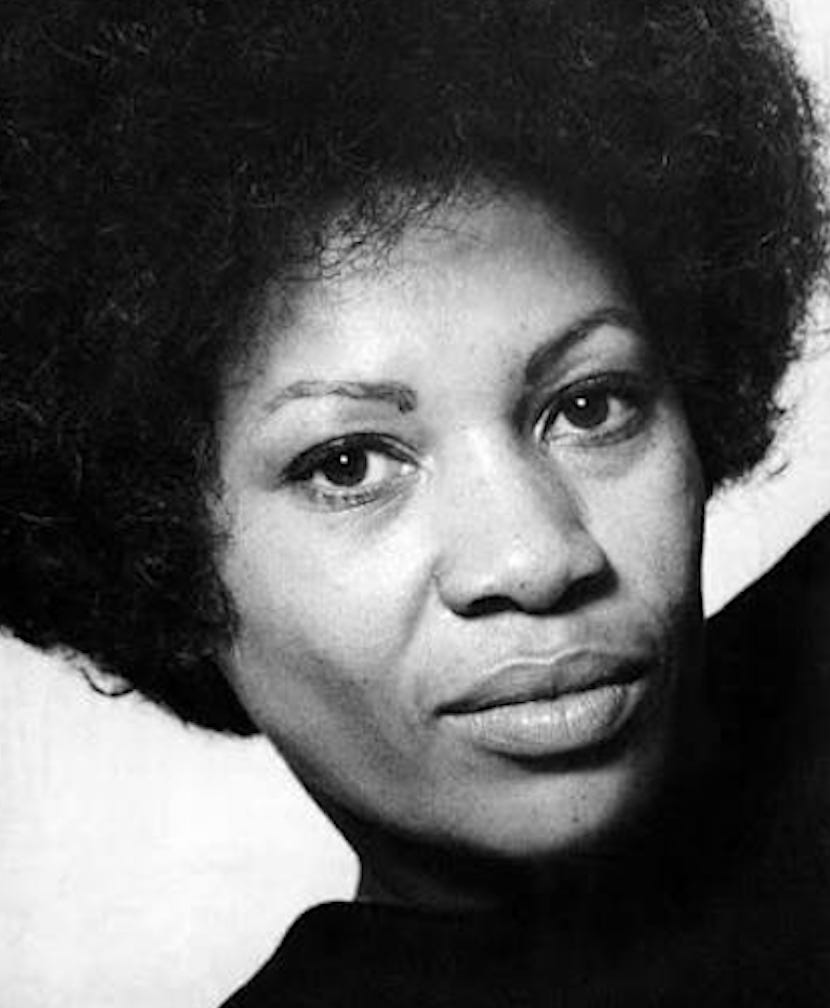
This week, I’m sharing a short excerpt from Anxieties of Experience on Toni Morrison’s Song of Solomon. It comes from a chapter that revisits the oft-discussed “hemispheric” literary line passing from William Faulkner to Gabriel García Márquez to Morrison. In the first part of the chapter I suggest that, while the novels of all three writers bear certain affinities, Morrison is ultimately closer to Faulkner in upholding an experiential aesthetics.
In part, my reading of Song of Solomon in the chapter was meant to challenge an influential set of interpretations of her work in the 2000s and 2010s. For scholars such as Walter Benn Michaels and Kenneth Warren, Morrison was symbolic of a post-1960s US literary tradition that privileged identitarian concerns over all others. Although I sympathized with many aspects of their scholarship, and could myself identify moments in Morrison’s texts and public statements that would support this contention, I felt that her oeuvre as a whole offered a far more complex reflection on race and subjectivity than they gave her credit for.
In short, I believed that Morrison was more invested in experience than in identity as such, experience understood in the (John) Deweyan sense of “the fulfillment of an organism in its struggles and achievements in a world of things.” Scholars such as Michaels tend to collapse the distinction between experience and identity, insisting—not without some validity—that the dominant US discourse of identity politics assumes that one’s personal experience derives principally from one’s racial, gender, or sexual identity. Yet this was not how Dewey and other major early-20th century aesthetic theorists in the US understood experience. As Dewey put it in his influential 1934 book Art as Experience, “It is the fate of a living creature…that it cannot secure what belongs to it without an adventure in a world that as a whole it does not own and to which it has no native title.” In my view, Morrison’s artistic vision, at least in her writings of the 1970s and early 1980s, hews far closer to Dewey’s pragmatist aesthetics than to the rigid twenty-first-century identity essentialism that Michaels, Warren and others have reasonably critiqued.
Those interested in a more in-depth discussion of Morrison’s relationship to Deweyan pragmatism should check out Eddie Glaude’s In a Shade of Blue: Pragmatism and the Politics of Black America. In my view, Lois Parkinson Zamora’s Writing the Apocalypse: Historical Vision in Contemporary U.S. and Latin American Fiction and The Usable Past: The Imagination of History in Recent Fiction of the Americas are the best starting places for understanding US and Latin American historical fiction in a comparative context.
Rereading Morrison’s Song of Solomon as a deep engagement with the US literature of experience also forces us to revise certain assumptions about Morrison’s aesthetics that have become influential in American literary analysis over the past twenty years. Walter Benn Michaels has argued that Morrison’s “novels of identity” instantiate a multiculturalist tendency in postwar US literature that privileges “events that are experienced and transmitted rather than represented and known.” According to Michaels’s The Shape of the Signifier: 1967 to the End of History (2004), Morrison’s Pulitzer Prize−winning Beloved (1987) is the most canonical example of a prevalent postmodernist sleight of hand that converts history into memory. Referring to Beloved along with Art Spiegelman’s Maus (1986) as “historicist” rather than historical works, Michaels suggests that Morrison’s novel about the lingering traumas of slavery offers a misleading sense of continuity between past and present: “it redescribes something we have never known as something we have forgotten and thus makes the historical past a part of our own experience.”
In Michaels’s interpretation, the American reading public’s relationship to antebellum history becomes relatively akin to Quentin’s relationship to the story of Thomas Sutpen in Faulkner’s Absalom, Absalom!, defined by the understandable but ultimately misguided attempt to embody the past as a means of inheriting it. Rehashing a criticism that originated in his analysis of US modernist literature in Our America, Michaels complains that Morrison’s narrative efforts to build a bridge between late twentieth-century black subjectivity and the history of slavery elides the actual history that produces the condition of blackness in the first place, namely the formations and transformations of global capitalism. In Michaels’s final accounting, Morrison is guilty of a series of postmodern fallacies, replacing class with race, economics with identity, and history with memory. Similarly, in What Was African American Literature (2012), Kenneth Warren’s analysis of the post−Jim Crow literature of “racial self-affirmation” treats Morrison’s works as symptomatic of an idea of “redemption” that is “more spiritual than political, more intuitive than deliberative, more mystical than logical.” Both Warren and Michaels take issue with what they see as Morrison’s evasion of politics proper in the service of a politics of culture.
At a certain level, Warren’s and Michaels’s readings of Morrison enact a powerful critique of the essentialist underpinnings of post-1945 literary multiculturalism and identity politics. Ironically enough, however, the most glaring oversight in their evaluations of Morrison’s textual economy has everything to do with the status of labor, that is, with the actual work involved in the activity of “experiencing.” Michaels’s emphasis in The Shape of the Signifier on the ghost in Beloved as the narrative vehicle that compels the “transmission of heritage” from Sethe to Denver is telling. If the ultimate source of history and knowledge is natural (or even supernatural—in any case, beyond human agency), then the labor power necessary to acquire it becomes, as Michaels implies, insignificant or null. And indeed, there are moments in Beloved when the ghost of the murdered child functions as a kind of magical conduit between the traumatic experience of slavery and its “rememory,” allowing the young child Denver to relive the past “through” Beloved: “Feeling how it must have felt to her mother. Seeing how it must have looked.”
Yet Milkman Dead’s trajectory in Song of Solomon shows us that Morrison’s texts are equally invested in the cultural work that experiencing, remembering, and reconstructing such repressed vernacular history implies. John Brenkman has compellingly argued that the novel’s turning point occurs when Milkman’s search for his family’s treasure, the symbol of inherited material wealth, becomes displaced by his active pursuit of his family’s genealogy. By reorienting Milkman from capitalized culture to “oral and transitory culture,” Brenkman argues, “Morrison challenges the habit of thinking about cultural heritage in terms of monuments and masterworks. . . . Such a model is acutely inappropriate for the history of a people whose enslavement denied them literacy and whose oppression in the century since Emancipation denied them the material and institutional means of assembling a monumental culture.” Building on earlier work on the role of the militant black nationalist group the Seven Days in Song of Solomon, Brenkman describes Milkman’s metamorphosis as a response to both his father’s materialism and his best friend Guitar’s embrace of black separatism.
As a member of the Seven Days, Guitar anticipates certain strains of late 1960s Black Power and the Black Arts Movement, strains that stressed the homogeneity as well as the autonomy of the “black experience.” Guitar’s expressions of racial essentialism in Song of Solomon (“Not people. White people,” 155) echo Amiri Baraka’s late sixties assertion that “races are like feelings,” just as Guitar’s tit-for-tat formula for retributive racial justice functions as a literal rendering of Baraka’s notorious line that black artists should create “poems that kill.” Milkman finds an alternative to this idea of ontological blackness not only by rejecting Guitar’s strategy of combatting systemic structural oppression with random acts of violence, but also, and just as importantly, by redirecting his energies toward exploring the histories of the communities that such politico-artistic movements purported to represent. If, as Brenkman suggests in “Politics and Form,” the novel’s “literary act of recovery” has a “critical edge” because it suggests that the movements of the 1960s failed to connect with the “everyday life-world,” Milkman and Pilate bridge this gap by embarking on experiential journeys: immersing themselves in African American vernacular histories and social lifeworlds, while remaining mobile enough to avoid becoming rooted in identitarian positions. In other words, the novel is far more invested in the work of “experiencing” culture and history than it is in a reified notion of the “black experience.”
This desire to articulate active and “productive” practices of experiencing motivates both Pilate and Milkman in Song of Solomon. Pilate’s trajectory is fueled by her desire to pass through many communities of color rather than stay within any single one: “But Pilate did not want a steady job in a town where a lot of colored people lived. All her encounters with Negroes who had established themselves in businesses or trades in those small midwestern towns had been unpleasant. . . . Besides she wanted to keep moving.” The novel strongly correlates Pilate’s desire for geographical coverage (“mark[ing] her to roam the country”) with her cultural politics, which compel her to wrestle during her journey with “the problem of trying to decide how she wanted to live and what was valuable to her.” Unlike Ruth, whose lack of exposure to the many layers of African American life narrows her conceptions of family, success, and value, Pilate pushes the “boundaries of the elaborately socialized world of black people” and acquires “a deep concern for and about human relationships.”
Over the course of the novel, Milkman’s own cultural politics gradually shift from his parents’ embrace of the spirit of capitalism toward Pilate’s experiential model. Only after his immersion in the southern lifeworld does he learn to treat the daily practice of Shalimar’s inhabitants—the children’s recitation of the “song” of Solomon—as a living document encoding the town’s past. This moment, when Milkman finally recognizes that “these children were singing a story about his own people,” comes after a lifetime of working to understand his family’s past and his own place within it. We might say that what Pilate and Milkman both share with Quentin Compson is the belief that the only way to shatter the mythologies of a self-contained identitarian unit—“the South” in Absalom, Absalom!; the “socialized world of black people” in Song of Solomon—is ceaselessly to test its on-the-ground realities and absorb its multiple (and often contradictory) histories.
Morrison’s 1955 Master’s thesis emphasizes exactly this pedagogical labor of investigation and communication in Faulkner’s novel: “In Absalom, Absalom! Faulkner puts Quentin through a thorough learning process and gives him the task of assimilating, under the eyes of an outsider, Shreve, all that he has been exposed to in the South.” Morrison’s references to the “learning process” and the “task of assimilating” seem much closer to an antifoundational pragmatist understanding of the constitution of subjectivity than to the identity-based position that Michaels has attributed to both Faulkner and Morrison. Extrapolating from her observation on Faulkner, we might say that Absalom, Absalom! and Song of Solomon both develop a principle central to the US literature of experience: the very activity of experiencing is a form of “full-time” cultural work requiring geographical coverage (moving), immersion in the history and the reality of a lifeworld (looking, listening, smelling), and the capacity to construct a narrative that captures the particularities and complexities of this “exposure” (telling).
Although one could argue that this labor is problematic to the extent that it remains attached to certain presuppositions about its object of study (i.e., that something like “the South” or “the black community” actually exists as a historically continuous whole), such heuristics seem neither more nor less problematic than Warren’s and Michaels’s distinctions between “political” and “cultural” investments. The important point, at any rate, is that we should make a better effort at understanding the aesthetics of experience in these US writers before we assess them normatively.